The conversation about hospital technology is almost always framed around efficiency. Faster billing. Fewer administrative errors. Better reporting. These are real benefits — but they are the secondary consequences of a more fundamental problem.
When hospital systems don't communicate, the primary casualty is not efficiency. It is clinical care.
The Invisible Gap in Every Fragmented Hospital
Most hospitals operate on between seven and twelve disconnected software systems. An EHR for clinical records. A separate system for lab results. Another for radiology. A different platform for pharmacy. A billing system that doesn't connect to any of them.
Each system does its job in isolation. The problem is not what each system does. The problem is what happens in the space between them.
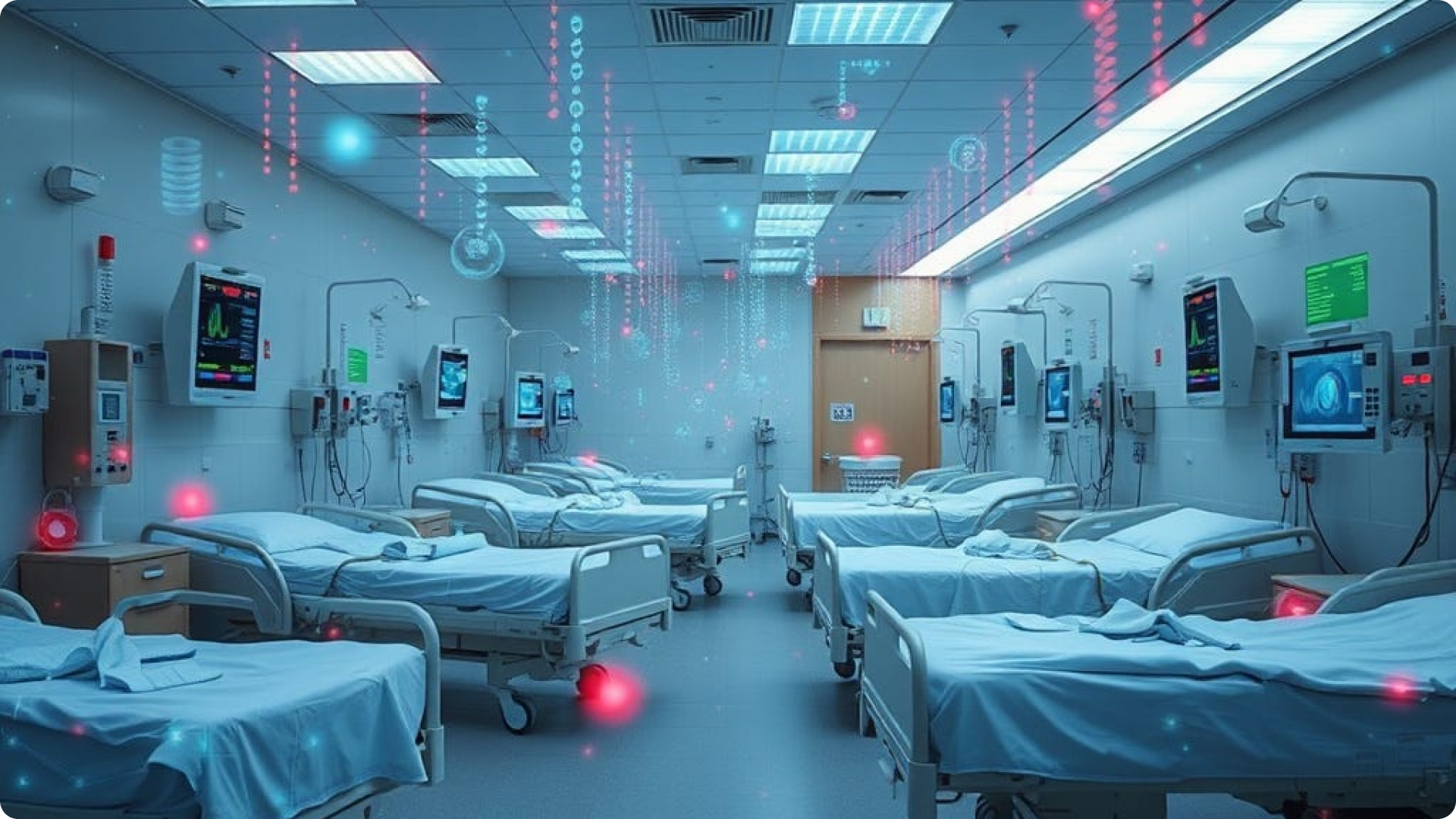
That space — the gap between one system and the next — is where clinical information gets delayed, distorted, or lost entirely. And in a hospital, delayed or lost clinical information is not an administrative inconvenience. It is a direct risk to patient safety.
What the Gaps Look Like in Practice
The consequences of fragmented hospital systems show up in specific, recurring patterns that clinical staff recognise immediately.
The Clinician Who Can't Find the Record
A patient arrives in emergency. They have been treated at the same hospital three times in the past year — but their records live in a different system than the one the emergency team uses. The clinician makes a decision without full clinical history. A drug is prescribed that interacts with a medication the patient is already taking. The interaction is in the record. The record is in a different system.
This is not a rare scenario. It is a daily occurrence in hospitals where clinical systems are not unified.
The Lab Result That Arrived Late
A critically abnormal lab result is generated. In a connected system, it triggers an immediate alert to the treating clinician. In a disconnected system, the result sits in the lab platform until someone manually checks it, prints it, or sends it through an internal messaging system that may or may not be monitored.
The time between a critical result being generated and a clinician acting on it is one of the most significant variables in patient outcomes. Fragmented systems extend that time. Unified systems eliminate it.
The Medication That Was Dispensed Without the Allergy Flag
A patient's allergy is recorded in the EHR. The pharmacy system does not connect to the EHR. A prescription arrives in pharmacy without the allergy information attached. The pharmacist dispenses the medication. The patient receives it.
In a unified system, the allergy flag is visible at the point of prescribing, at the point of dispensing, and at the point of administration. In a fragmented system, it exists only where it was recorded — and invisible everywhere else.
The Surgical Team That Operated Without the Latest Results
A patient is prepared for surgery. Imaging results from the previous day are sitting in the radiology system. The surgical team's workflow runs on the EHR. The results were not manually transferred. The surgical team proceeds with the information they have. The information they have is incomplete.
The Administrative Burden That Falls on Clinical Staff
Fragmented systems don't just create clinical risk — they redirect clinical time away from patients and toward administration.
When systems don't communicate, the work of connecting them falls on people. Clinicians become data transfer agents — logging into multiple systems, cross-referencing results manually, re-entering information that already exists somewhere else in the hospital.
Studies consistently show that clinicians in fragmented hospital environments spend between 30% and 40% of their working hours on documentation and administrative tasks. In a ten-hour shift, that is three to four hours not spent with patients.
This is not a workflow problem that can be solved by asking clinical staff to work differently. It is an infrastructure problem that can only be solved by changing the infrastructure.
What Unified Clinical Infrastructure Changes
The clinical case for unified hospital systems is straightforward. When every department operates from the same patient record, on the same platform, in real time, the gaps disappear.
A single patient record means every clinician — in emergency, in the ward, in the lab, in pharmacy — is working from the same information at the same time. No version conflicts. No missing history. No decisions made on incomplete data.
Real-time alerts mean that a critical lab result, an abnormal vital sign, or a drug interaction flag reaches the relevant clinician immediately — not when someone manually checks the other system.
Integrated pharmacy and prescribing means allergy flags, drug interaction alerts, and dosage recommendations are visible at the point of prescribing and the point of dispensing — automatically, without manual cross-referencing.
Ambient clinical documentation via voice-enabled tools means clinicians spend less time documenting and more time delivering care — with records that are structured, complete, and immediately available across the platform.
IoMT device integration means patient vitals from bedside monitors, ventilators, and ECG systems flow directly into the clinical record in real time — without manual entry, without delay, and with automated escalation when values move outside safe parameters.

The Leadership Dimension
For hospital leadership — CEOs, Medical Directors, and Board members — the clinical consequences of fragmented systems carry a dimension beyond patient safety.
Regulatory exposure increases when clinical documentation is incomplete or inconsistent. Accreditation bodies including JCI and NABH assess clinical documentation quality as a direct indicator of care standards. Fragmented systems make consistent, complete documentation structurally difficult — not because clinicians are careless, but because the systems they work in make completeness hard to achieve.
Liability exposure increases when clinical decisions are made without full patient history, when drug interactions are missed because allergy records live in a disconnected system, or when critical results are delayed because no automated alert mechanism exists.
Staff retention suffers when clinical teams spend a third of their shifts doing administrative work that a unified system would eliminate. The administrative burden of fragmented hospital infrastructure is one of the most consistently cited contributors to clinical staff burnout — a challenge that has direct operational and financial consequences for every institution that experiences it.
The Question That Matters
The question for hospital leadership is not whether fragmented systems create clinical risk. The evidence for that is consistent and well-documented.
The question is whether the infrastructure currently in place is capable of eliminating that risk — or whether it is, by its architecture, the source of it.
A hospital where clinical records, pharmacy, diagnostics, and patient monitoring all share the same real-time data layer is not a more technologically advanced hospital. It is a safer one.
Svensa unifies clinical records, pharmacy, diagnostics, IoMT monitoring, and AI-assisted decision support on one platform — eliminating the gaps where clinical information gets lost.
Request a demo to see how unified clinical infrastructure works inside Svensa.